
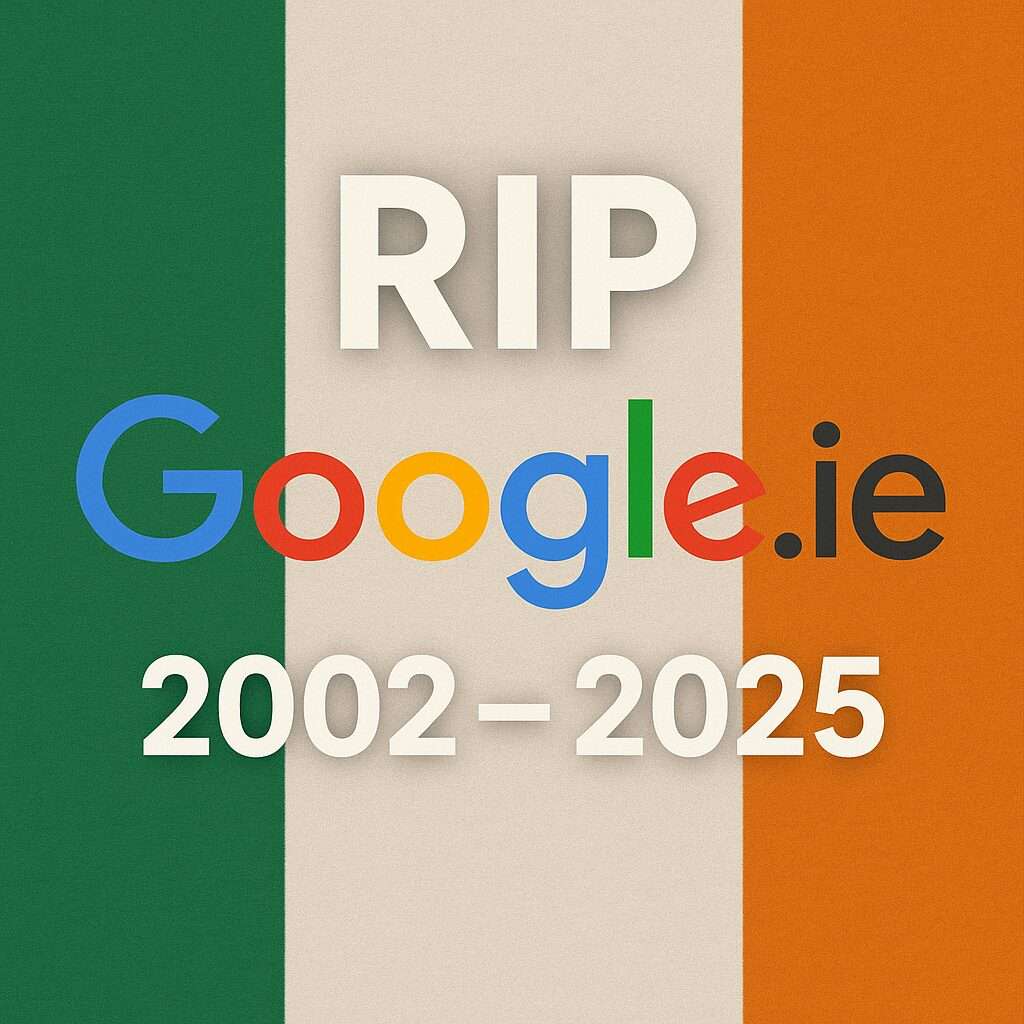
Google.ie – It’s Not Dead, Just
Migrated
The internet is changing fast. Search and SEO has changed a lot so far in 2025 alone. It’s hard to keep up with all the developments in AI that are happening in the industry. Now, on top of everything else, Google.ie is gone! It finally slipped away without much fanfare. Also gone are the other country-specific versions of Google; Google.ca, Google.com.au and Google.co.uk. The looks to have been finally killed off on Friday, June 20, according to Wayback Machine (the Internet Archive).
Like the Gulf of Mexico, Google the search engine, of course, is still here, it’s just now accessible under a different name—the mighty .com extension. A .com domain is known as a gTLD (generic Top-Level Domain, as opposed to a ccTLD (country code TLDs) such as .ie or.co.uk.
Most people wouldn’t even notice any difference as the .ie version is now being instantly redirected to the Google.com page. The look and localised features of the .ie version are just now on the .com version. The notification that ‘Google offered in: Gaeilge’ and link to the Irish-language version of the page is still there on the Google.com version for localised Irish users.
Google had announced this change back in April. Not many outside the world of search, or SEO, likely paid much attention to this news, although it was picked up in the Journal.ie (Irish SEO Aoife McIllraith commented on the changes).
According to the publicly available Whois information, Google.ie was created on 21 March 2002. It had a good run but now will likely be forgotten in the annals of internet history.
Google’s
Announcement
Google had announced this change back in April in a blog post ‘Here’s an update on our use of country code top-level domains’.
Since then, it began moving from the country code top-level domains to Google.com gradually over the past few months. I found a list of 197 ccTLDs that Google was using. Of these, nine are still live including https://www.google.cn/ (China), https://www.google.com.hk/ (Hong Kong), and a few random Caribbean island domains. It’s good to see that Google followed its own SEO advice or ‘general best practices for site moves’ when making the move. In its documentation on ‘How to move a site’, number one on the list of things to do is ‘Split your move into smaller steps, if that makes sense for your site.’
In the announcement blog post, Google gave the background and the reasons for the change:
“Historically, as a part of our process to provide localized results, we’ve used country code top-level domain names (ccTLD), such as google.ng for Nigeria or google.com.br for Brazil.
Over the years, our ability to provide a local experience has improved. In 2017, we began providing the same experience with local results for everyone using Search, whether they were using google.com or their country’s ccTLD.
Because of this improvement, country-level domains are no longer necessary. So we’ll begin redirecting traffic from these ccTLDs to google.com to streamline people’s experience on Search. This change will be rolled out gradually over the coming months, and you may be prompted to re-enter some of your Search preferences in the process.
It’s important to note that while this update will change what people see in their browser address bar, it won’t affect the way Search works, nor will it change how we handle obligations under national laws.”
Why Change and What this Means for Search?
This doesn’t really change anything for search or SEO at all. Usability is the same and there shouldn’t be any issues with Google Analytics reports. If things do go wrong with the search results it will be difficult to attribute them to this change as so many changes are being made to the search results and new features are being added.
Apart from the reasons Google gave in its announcement, there are many reasons why Google may have killed off the ccTLDs. Having one domain is difficult enough to manage, but 190+ domains is expensive to maintain and there is likely a lot of administration and local regulations to adhere to.
From An SEO
Perspective
Moving from a ccTLD to a gTLD (i.e. Google.co.uk to Google.com) is technically a website migration. Working in SEO, I was curious to see how Google adhered to its own best practices.
In Google’s documentation on ‘How to move a site’ there is a section on ‘Plan your redirect strategy’. Some of the relevant information in this says:
“Use server side permanent redirects if technically possible. Although Googlebot supports several kinds of redirects, we recommend that you use HTTP permanent redirects if possible, such as 301 and 308.
Avoid chaining redirects. While Googlebot can follow up to 10 hops in a “chain” of multiple redirects (for example, Page 1 > Page 2 > Page 3), we advise redirecting to the final destination directly. If this is not possible, keep the number of redirects in the chain low, ideally no more than 3 and fewer than 5. Chaining redirects adds latency for users, and not all user agents and browsers support long redirect chains.”
Of the 198 ccTLD URLs that I checked, 185 redirected to https://www.google.com/ via one 301 permanent redirect, which is best practice. One URL, https://www.google.gf which is the French Guiana ccTLD, redirected via a 302 temporary redirect, which is not best practice. Two URLs, https://www.google.co.pn and https://www.google.com.lc which are the ccTLDs of Pitcairn Islands and Saint Lucia, did not redirect at all. These look to be part of an older migration going back to 2015, according to visibility records in Wayback Machine. In relation to that, in the same documentation, Google says to:
“Keep the redirects for as long as possible, generally at least 1 year. This timeframe allows Google to transfer all signals to the new URLs, including recrawling and reassigning links on other sites that point to your old URLs. From users’ perspective, consider keeping redirects indefinitely. However, redirects are slow for users, so try to update your own links and any high-volume links from other websites to point to the new URLs.”
Again, looks like Google didn’t follow its own guidelines here in terms of keeping redirects indefinitely.
When checking redirects in a website migration, I usually check how the non-www, and HTTP versions are handled. The Google.co.uk domain looks to have been migrated on Friday, June 20, according to Wayback Machine (the Internet Archive). In the case of the non-www HTTP version of the Google.co.uk URL, there are a few hops that include both 301s and a 302 in the mix. This is definitely not best practice.

As Google’s documentation mentioned, redirects are slow for users. I used a tool to check this and got the following data:
- Redirect 1 latency: 315.26 ms (rated poor)
- Redirect 2 latency: 345.2 ms (rated poor)
- Redirect 3 latency: 275.22 ms (rated moderate*)
Again, users likely wouldn’t notice this but it is another example of Google not following its own guidelines.
I will do a blog post on the pros and cons of using a .ie domain versus a .com domain in the future. But for now I’ll be sticking to my .ie domain name.
Google.ie was with us for just over 23 years. Will it be missed?

If you have an upcoming website migration project where you are changing some URLs or moving from a .ie to a .com (or vice versa), make sure you plan it accordingly. Otherwise feel free to get in touch with me and I can help you through the migration process.
Leave a Reply